
What is "Enough?"
Is it a bag limit for everyone? Or is it something more?

About thirty years ago, I was guiding a group of eight gentlemen on a snow goose hunt in the Champlain Valley of Vermont. At the time, US Fish and Wildlife was beginning to recognize that the population of snow geese that bred in the Ungava Peninsula of Hudson Bay was headed toward a potential catastrophe. Their feeding method of uprooting rhizomes, called “grubbing,” in brackish marshland was altering the ecosystem. It was decided that it was necessary to increase the harvest limits to reduce the population to more sustainable numbers. Biologists had pondered the possibility of an avian influenza outbreak that could decimate thousands of birds in a location being heavily used for their preferred food source. As the birds began their fall migration in late September through October, these birds would pass through the Champlain Valley of western Vermont and use the Dead Creek Refuge in Addison as a stopover. Hunters began to take a strong interest in hunting them since daily bag limits had been increased to fifteen birds a day. But they were quite different prey with habits that the Canada goose hunters found difficult to pattern. As an independent contractor working for a guide service, it was my job to find sports that wanted to hunt them, organize the crew, and make sure they were all legal and willing to work.
One hunt will stand out in my memory as one of the most extraordinary hunts of my life. It was mid-October, and the refuge was holding an estimated 14,000 birds. Each morning the flocks would launch en masse and fly around the valley looking for the perfect feeding spot. They would seek a field that had just been cut or tilled with plenty of waste still on the ground. The field had to be big (by Vermont standards), big enough that the flock could safely feed there undisturbed. My hunting partner at the time had found a tilled field the evening before and babysat them until they left for their roost on the refuge at dusk.
I had organized a group of eight shooters, all friends, whose most influential member was a well-known local restaurateur who had built an exceptional reputation for the highest quality food service in the state. He had a deep reverence for animals and a passion for hunting. He and his entourage had hunted bighorn sheep in British Columbia, mule deer, antelope, and whitetail all over the continent. They knew what a memorable hunt looked like and likely had some lofty expectations for this goose hunt. The lead member of this merry band was named “Tony.” I had worked in one of his restaurants and grew to admire his values and spirit. He was not only a gentleman with a terrific sense of humor but also held a deep respect for the spirit of the hunt. Indeed, he once confided in me that he believed that he had been a buffalo in a past life, and that is why he had a buffalo farm in the town he called “home.”
When the crew arrived, everyone was puzzled why they had been given the absurdly early start time of 3:00 am. But when the trailer arrived, and the lights inside lit up its contents, jaws dropped in awe. The lead guide, my partner at the time, barked out, “OK, boys (these gentlemen were in their 50s), we’re going to set out a big spread. It’s the only way these birds will commit.” At the time, a “big spread” for hunting Canada geese was 50-60 decoys. When one of the gents piped up, “How many is ‘ big ‘? The answer hung in the air with a dead silence. I overheard one of them say, “Tony, what the hell have you gotten us into?” “Two thousand decoys?” You’ve got to be kidding!”
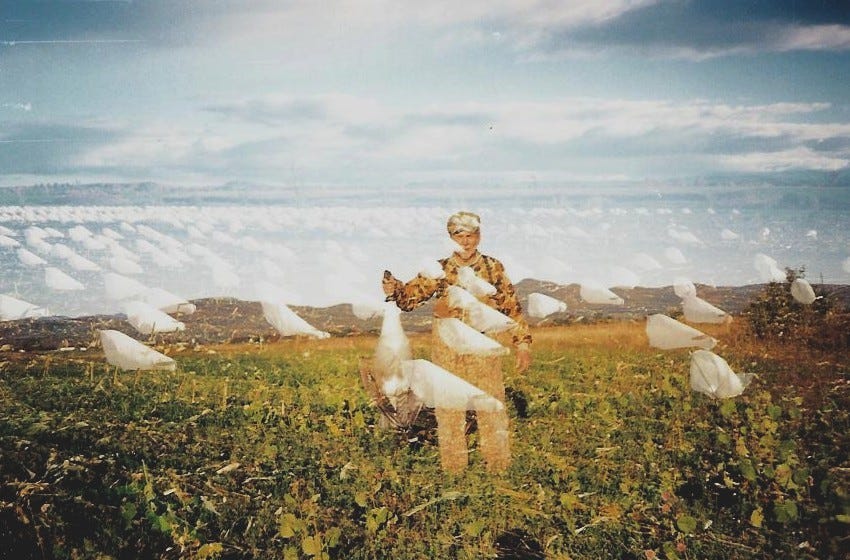
As we handed the bagged decoys in pouches of one hundred Texas rags, the white windsocks with black “x’s” on their backs and a wooden dowel around which the windsocks were tied and taped. With a 6:35 am legal shooting time, we had just three hours to put out 2,000 decoys. Normally this would be difficult enough. Simple, but difficult. Unravel the windsock with the opening facing into the wind and push the wooden dowel into the soil at a 45-degree angle, allowing the wind to fill the sock and make it “wiggle” in the wind current. Except. The field we were hunting in was in Addison County, which is known for its world-famous clay that had been left in the valley by the last retreating glacier. Georgia clay is widely accepted to be the slipperiest surface on earth when it rains, and Addison County clay is also quite slippery when wet. But after a dry spell, it might be acceptable as a foundation for a skyscraper. It was not simply hard. It resembles concrete. Fortunately, it was at least tilled. Pushing these dowels into the ground with our palms required sturdy leather gloves. And so, those of us without leather gloves used our regular duck hunting gloves, which after a few hundred dowels would develop a sticky red palm where our hands were bleeding through the polyester material. “This better be worth it!” I overheard someone say in the dark, a cylinder of light from their headlamp surrounding them.
By 6:15, eight of the sports and I stumbled to a ditch at the north end of the field and tried to make ourselves invisible. We covered ourselves with some of the local vegetation, organized our snow goose calls and field bags loaded with coffee, donuts, and sandwiches. The lead guide left to attend another field full of more sports. We leaned back and waited.
The sun slowly rose over the distant mountains to our east, and we all commented on the beautiful pastel sunrise.
Around 7:15, as we were lounging in the ditch, the eighth man on the far end of the line shouted out in his loudest whisper, “Hey! Guys! Do you hear that?” The birds were on their way. But would they return to the field they had fed undisturbed the night before?
The raucous and unmistakable sound of “snowies” built to a crescendo. They were flying toward us just behind the tree line at our backs. We began calling the short “pig-like” honks that these birds make. A staccato, grunt-like sound that began to fill the air. In less than a minute, they were above us. “No one move until I call the shot. Got it?” I commanded.
What we witnessed next was one of the most exciting moments in my waterfowl hunting career. The birds began circling counterclockwise, in a reverse tornado. As they were stacked up vertically in the swirling mass, I turned to the sportsman next to me and said, “We are decoying the entire refuge!” As is their strategy, the mature birds, with a snow-white body, pinkish legs, and a rusty stain on their faces from grubbing for forage in the St Lawrence, let the juveniles descend first. These birds haven’t lived through a hunting season before and do not understand the danger of committing early. The mature birds above them let the “juvies” land first. I did not call the shot right away and let the young birds land without discharging a shot. With a hundred birds on the ground and the remaining flock committing, I called the shot. With 14,000 birds all calling, no one heard my command, so I sat up and raised my gun. I did not shoot at first, but my movement let the team know it was time.
Eight shotguns were raised, but not one shot could be heard. I could see the guys reloading and the concussive motion of their shotguns, then another three rounds, reloading again, and shooting again. Not one shot could be heard above the cacophony of the grunting honks of the flock as they descended. Birds were dropping like October leaves. As the juvenile birds hit the ground, the mature birds misunderstood their landing as a sign that “It’s safe to come down now that the young ones have landed.” Not even the birds themselves could hear above their own honking.
At this point, the man that I admired stood up in the line and waved his arms, looking at his friends and said loudly, “That’s enough.” As he stood up, the remaining flock took to the air, and within less than a minute they could be seen in the distance as a wave of white moving from side to side seeking a route back to the refuge. Without any questions or complaints, these men listened to their leader and felt no loss of opportunity to shoot more birds.
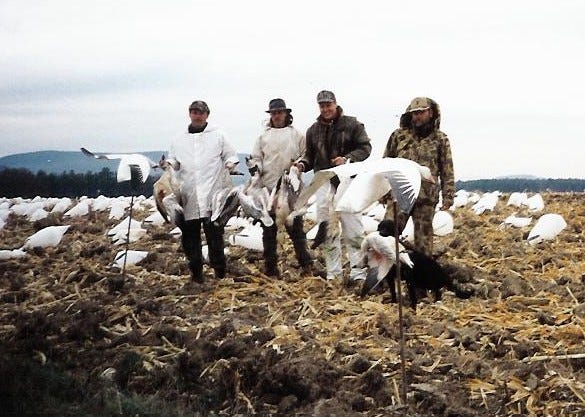
As a young guide, whose reputation relied on getting his sports “on birds” and trying my best to achieve bag limits for all, I found it curious that Tony felt that this was “enough.” He was the hunter we all become when we finally understand what is “enough.” With forty-four birds on the ground and a legal limit of 120, it became clear to my young mind that for a hunter to become a true sportsman, the success of a hunt and the value of a great memory are never about filling the bag limit. It was about taking only what we need.
When I pass back into the Great Star Nation, I will be looking for my friend, the buffalo.
The part I enjoyed most isn't just that Tony called it. It's how eight others with loaded guns and birds still committed lowered them on one word, and nobody argued. He didn't just know his own limit. He called it out loud and trusted them to hold it with him, and they did. That's a rarer thing than restraint. That's restraint that a group quietly agrees to carry together. Sounds like Tony was the kind of man worth knowing and sharing a blind with. Thank you for this story.